
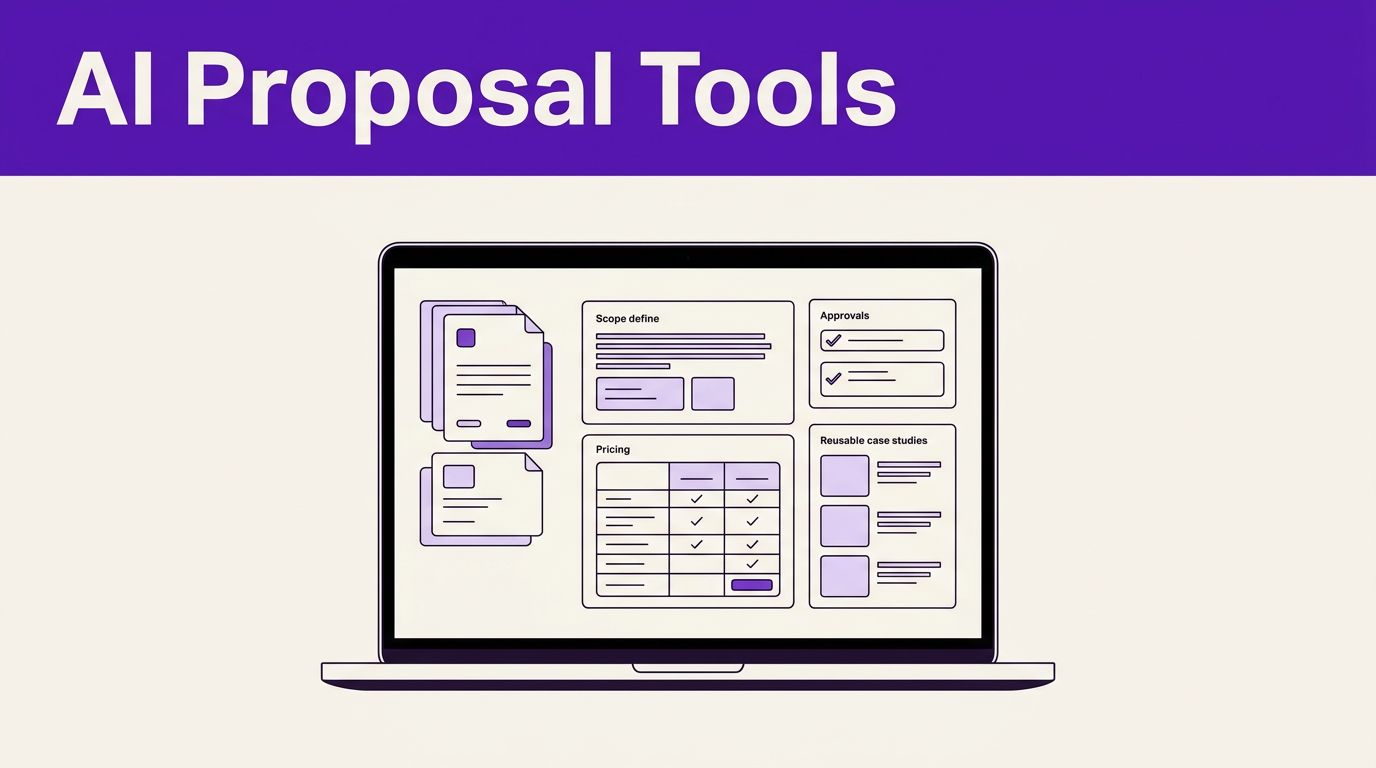

A strong proposal can win attention before the first sales call ends. Yet many agencies still lose hours assembling case studies, revising scopes, chasing approvals, and rebuilding pricing tables for work they have already sold before.
The right tools reduce that repetition through automation, helping teams reuse approved proof, personalize faster, and keep scope details under control.
The goal is a proposal process that gives account teams more time to sell the work and less time formatting documents.

Key Takeaways
- Choose a tool based on your agency’s primary workflow: client-facing proposals, design-led pitches, high-volume proposal operations, or formal RFP responses.
- Generative AI can accelerate drafting and personalization, but approved content libraries and retrieval-based systems are safer for claims, pricing, scope, and compliance details.
- Build governed templates, reusable content, approval steps, and clear ownership before asking AI to produce proposals.
- Protect confidential client and commercial information with vendor security reviews, access controls, and human oversight.
- Measure time saved alongside review rounds, content reuse, win rate, sales-cycle length, scope changes, and client feedback before judging a platform’s value.
Start with the agency job, not the AI feature
An agency rarely needs one kind of proposal. Recurring business proposals, new-business pitches, monthly SEO retainers, paid-media scopes of work, and formal tender proposals each demand different content and review steps.
That creates two clear software categories. Client-facing proposal builders help your sales team send polished scopes, pricing tables, e-signatures, and payment-ready documents. RFP response platforms help larger teams answer detailed requirements using a controlled content library.
Before comparing proposal software, map the document workflow your team uses most often. Note how proposals begin and which repetitive steps could benefit from automation. Then record who approves them, where case studies live, and which documents need e-signatures. A category-first evaluation guide is useful because it separates these use cases instead of treating every platform as the same product.
For most marketing agencies, the buying criteria should include:
- How quickly a strategist can turn discovery notes into a project scope without inventing deliverables.
- Whether the platform protects approved templates and brand components, plus pricing rules, legal terms, and brand voice, from casual edits.
- How well its CRM integration supports your accounting process and client handoff workflow.
- Whether managers can see who reviewed a proposal, what a prospect viewed, and where a deal stalled.
Freelancers may have lower-volume needs, so a lighter workflow can be the better fit.
A design-heavy proposal with weak approval controls creates a different problem than a secure RFP platform that produces lifeless client documents. Match the tool to the bottleneck.
Best AI proposal writing tools for marketing agencies
The best option depends on what your agency sells and how buyers make decisions. A brand studio pitching a six-month campaign needs a different experience than a performance agency answering a 90-question procurement document.
This comparison separates the main options by their practical agency role and the needs of the sales team. For a wider market view, see this 11-tool AI proposal software comparison.
| Tool | Best agency fit | Strengths | Watch for |
|---|---|---|---|
| PandaDoc | Agencies needing proposals, contracts, and payments | Templates, catalog items, e-signatures, CRM connections | Interactive design is less central than in Qwilr |
| Qwilr | Design-led proposals and premium sales pitches | Web-style pages, embedded media, pricing, buyer analytics | May need more process controls for complex approvals |
| Proposify | High-volume proposal operations | Content controls, approvals, layout options, analytics | Requires solid template governance |
| Responsive | Formal RFP and security-questionnaire work | Requirement-based AI help, response workflows, validation | Less suited to visual sales proposals |
| Loopio | Enterprise content-library management | Approved answer reuse, content maintenance, RFP workflows | Not designed as a client-facing proposal builder |
PandaDoc, Qwilr, and Proposify for client-facing proposals
PandaDoc is the broadest option for an agency that wants proposals to sit inside a larger document workflow. It combines reusable templates, a product catalog, CRM integration, comments, version control, e-signatures, and payment collection. That makes it practical when a signed proposal should pass through automation into a service agreement or invoice process.
For retainers, build catalog items for recurring services such as paid-search management, monthly reporting, conversion-rate optimization, and content production. Your team can then adjust quantities and optional add-ons without rebuilding pricing tables.
Qwilr fits agencies where presentation affects the sale. Its browser-based proposals let buyers review and sign online with e-signatures, embedded video, calendars, forms, interactive pricing, and engagement data. A creative agency can make a campaign concept feel more like a polished microsite than a static PDF.
Use Qwilr when a visual story, strategic positioning, and an easy client review experience matter more than elaborate internal routing. Keep the scope language controlled, though. Attractive pages can still create disputes when assumptions or out-of-scope items are vague.
Proposify is a strong option for teams that need more discipline around proposal production. It emphasizes detailed page layouts, content libraries, approval workflows, locked brand components, e-signatures, and proposal analytics. Agencies with several account directors often benefit from its ability to prevent off-brand copy or unauthorized changes to pricing tables.
Published pricing changes often, and plan limits matter as much as headline rates. As of August 2026, public comparisons commonly place Qwilr near $35 per user per month, while Proposify and PandaDoc prices vary by plan, billing cycle, features, and user count. Confirm current terms, included integrations, guest access, and e-signature limits before budgeting.
Responsive and Loopio for RFP response work
Responsive and Loopio belong in formal bid work. They suit agencies that compete for enterprise work through a tender proposal, vendor questionnaires, and technical proposals.
Responsive uses AI-assisted response suggestions and collaboration workflows to help teams match content to bid requirements. It is useful when a bid manager must coordinate subject-matter experts, track unanswered items, and check responses before submission.
Loopio centers on a content library. Teams can reuse approved responses for company facts, security policies, data handling, service methodology, and case-study evidence. Content freshness controls matter here because old proof points can damage credibility faster than a slow first draft.
Enterprise RFP software should offer permission controls, assigned owners, answer status, search across approved content, review history, exports, and requirement tracking. Government or highly regulated work often adds strict formatting and compliance rules, as this overview of federal contractor proposal tools illustrates.
Neither platform replaces a client-facing sales proposal builder for most agencies. They solve the heavier operational problem of finding, validating, and coordinating responses at scale.
ChatGPT, Claude, Jasper, and other writing assistants
General AI assistants, including generative AI tools like ChatGPT and Claude, complement rather than replace a proposal system. From discovery notes, they can create a first draft or executive summary and support content creation. They can also adapt messaging for a new vertical while preserving brand voice.
Unlike discriminative AI systems built on approved answers, they don’t independently verify pricing, claims, scope, or references. Polished copy can still invent metrics or promise unapproved work. Use them for repeatable drafting automation, not governed proposal production.
The same accuracy concern applies to grant writing, but agency requirements differ, as this proposal writing software review shows.
Teams that want to test prompting before purchasing a platform can start with Free AI Tools. Use them to improve an approved outline or rewrite internal notes, then move validated material into your governed template.
Generative AI versus discriminative AI and approved-answer systems
Many vendors use “discriminative AI” for software that searches, ranks, and retrieves content from a closed library. In machine-learning terms, discriminative models classify or score inputs. Artificial intelligence is the broader category. For agency buyers, the distinction is simple: can the tool retrieve approved answers, or does it generate new language?
Generative AI creates draft text based on your prompt and context. It works well for executive summaries, campaign rationales, discovery recaps, and concise explanations of a proposed channel mix. However, it can also fill gaps with assumptions.
A governed content library contains approved case studies, credentials, pricing logic, legal clauses, bios, proof points, and service descriptions. Retrieval-based systems pull those materials into the response, making factual review easier. Workflow automation can route retrieved evidence for review, but it can’t replace factual accountability.
In a final evaluation, ask whether the tool’s discriminative AI can trace a claim to an approved case study, pricing rule, or policy. If it cannot, treat that line as a draft, not proposal evidence.
The strongest agency workflow combines both approaches. Let draft generation shape the narrative around a prospect’s goals. Then require it to draw service descriptions, claims, and terms from approved source material.
Personalization should alter emphasis, examples, and language. It should never alter the facts. A healthcare prospect may need more detail about privacy controls, while an ecommerce brand may need channel forecasts and merchandising examples. The underlying proof still needs an accountable owner.
Build the proposal system before asking AI to write
AI output improves when the agency gives it clean source material. Dumping old PDFs, disconnected slide decks, and unapproved case studies into a workspace produces inconsistent proposals faster.
Start with a practical build process:
- Review the last 20 proposals and identify content that repeats. Pull out service descriptions, standard assumptions, pricing language, legal clauses, client proof, and common objections.
- Create a content library with clear ownership. Tag every item by service line, industry, funnel stage, date reviewed, proof status, and internal owner. Retire obsolete claims instead of leaving them searchable.
- Build proposal templates around real selling motions. A new-business proposal, an audit scope, a campaign retainer, and a formal response should each have their own structure.
- Set controlled prompts for each template. Include the audience, client goals, approved services, brand voice, source documents, and instructions to flag unknown facts rather than invent them.
- Require review before a document is sent for e-signatures. A strategist checks positioning, a delivery lead checks the project scope, and a commercial owner checks fees, terms, and risk.
Each proposal template should make room for an executive summary, objectives, recommended approach, deliverables, timeline, investment, assumptions, optional work, and next steps. That structure helps AI fill the right spaces without burying a client in generic background copy.
Pilot one repeatable workflow, such as SEO audits or paid-media retainers. Test whether workflow automation reduces assembly time without bypassing review. Compare the new process against your old one for 30 days. A broader proposal software comparison can help expand a shortlist, but a real agency proposal is a better test than a generic demo.
Data privacy and human review protect the relationship
A proposal often contains confidential client budgets, customer data, campaign results, staff bios, and commercial terms. Do not paste those materials into a public AI workspace if the client agreement, privacy policy, or internal rules prohibit it.
Ask each vendor direct questions about data privacy controls, data retention, model training, encryption, user permissions, single sign-on, audit logs, data residency, export controls, and deletion procedures. Review the contract language with the people responsible for legal, security, and procurement decisions.
A human in the loop is a commercial safeguard, not a formality. Writers must check each number, client name, case-study detail, platform claim, deadline, and scope boundary, while delivery leaders confirm capacity. Automation can surface missing fields or inconsistent claims, but it cannot replace that review.
AI can write a convincing explanation of attribution modeling or technical SEO. It cannot approve a contractual commitment, confirm a legal interpretation, or decide whether your agency can deliver an aggressive timeline.
Keep an approved final copy, including e-signatures, in your CRM or document repository after signature. This document workflow moves the record from sales to delivery and account management, helping teams compare the purchase with production’s work.
Measure time saved and proposal quality
Small agencies can save meaningful time once templates and libraries are mature. A standard proposal may drop from several hours of assembly and edits to a shorter review cycle. A custom strategic pitch still needs research, strategy, client context, and senior review.
Track baseline performance before rollout. Measure drafting speed and time to an approved proposal. Then track review rounds, the percentage of approved content reused, and corrections caught before sending.
Then compare labor value saved through automation with subscription fees, setup time, content cleanup, training, and administration. A tool that saves two hours on a recurring proposal type may justify its cost. A platform that only adds another approval step will not.
Document analytics can help, but they do not prove buying intent. A prospect who revisits pricing may have questions, while a prospect who shares the document internally may still lose budget approval. Review engagement data alongside win rate, average deal size, sales-cycle length, scope changes after signature, and client feedback.
Keep comparisons fair. Measure similar deal types over enough opportunities to avoid treating one large win or loss as proof that the software caused the result.
Frequently Asked Questions
What is the best AI proposal writing tool for a marketing agency?
The best option depends on the agency’s sales workflow. PandaDoc suits broader document processes, Qwilr fits design-led proposals, Proposify supports controlled proposal production, and Responsive or Loopio are better for formal RFP work.
Can ChatGPT or Claude replace proposal software?
General AI assistants are useful for first drafts, executive summaries, and personalization. They do not independently verify pricing, claims, scope, or references, so they should complement a governed proposal system rather than replace it.
How can agencies use AI without creating inaccurate proposals?
Use approved templates and content libraries with clear ownership, source documents, and instructions to flag unknown facts. Require strategists, delivery leads, and commercial owners to review positioning, scope, fees, terms, and claims before sending.
What should agencies check before buying an AI proposal tool?
Review workflow fit, CRM and accounting integrations, template controls, approval tracking, analytics, e-signature support, and content-library capabilities. Also ask about data retention, model training, encryption, permissions, audit logs, data residency, and deletion procedures.
How should agencies measure whether a proposal tool is worthwhile?
Compare drafting time, time to approval, review rounds, approved-content reuse, and corrections caught before sending against the old process. Include subscription, setup, training, and administration costs, then assess business outcomes such as win rate, deal size, sales-cycle length, and post-signature scope changes.
Choose software that makes approved work easier to sell
The right platform gives your agency a repeatable way to present its best work without recycling old mistakes. PandaDoc is a broad document choice with e-signatures, Qwilr suits design-led pitches, Proposify supports controlled proposal operations, and Responsive or Loopio fit formal RFP work.
The real advantage comes from a current content library, approved commercial rules, and automation used only with accountable review. That discipline keeps your brand voice consistent. AI proposal writing tools can reduce production time, but your agency’s judgment still determines whether the proposal earns trust.