
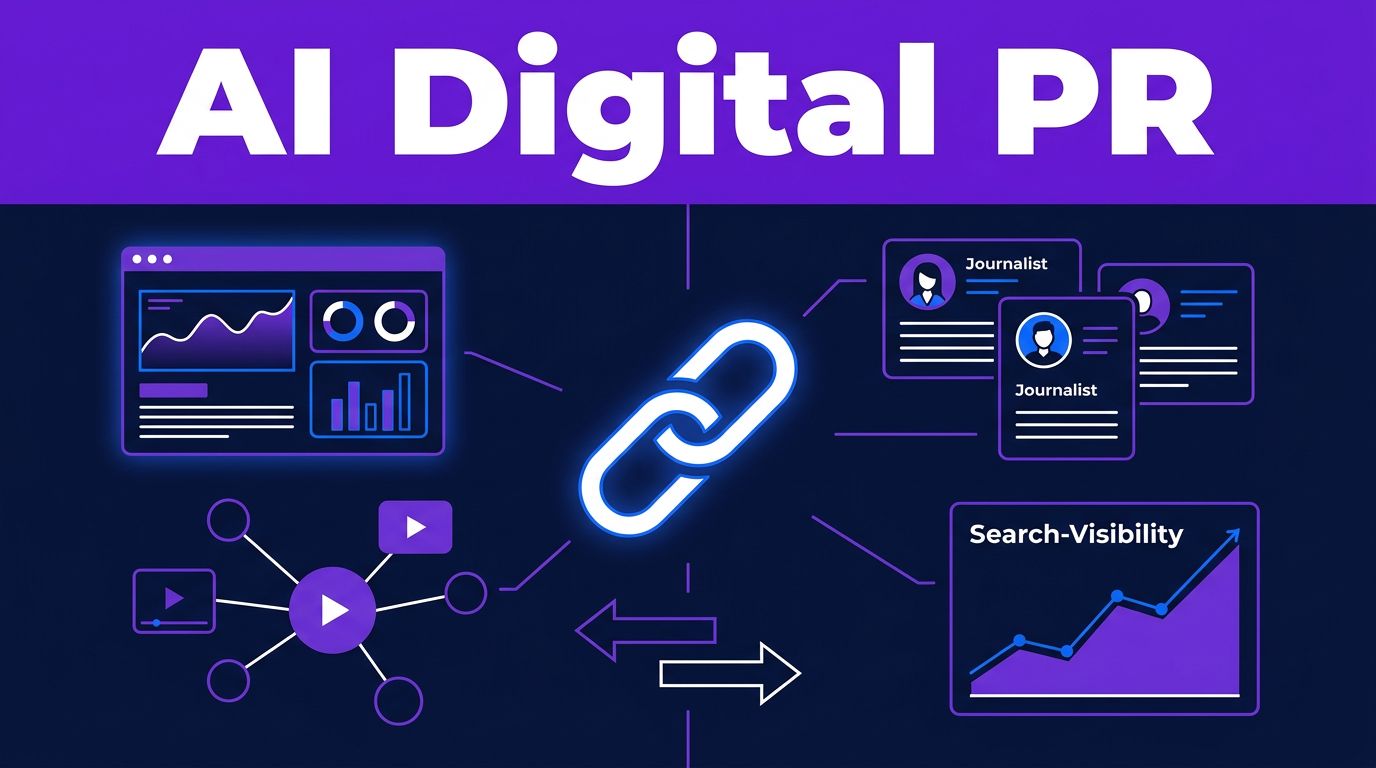


Well-planned digital PR campaigns can earn links that improve search visibility for years. Yet most teams still lose time to weak media lists, generic pitches, noisy monitoring alerts, and reports that never connect coverage to revenue.
The best AI digital PR tools help you research faster, spot relevant journalists, shape stronger stories, and measure what happened after a placement lands. They don’t replace editorial judgment or turn mass outreach into relationship building. Match the platform to your bottleneck, and keep backlink acquisition focused on relevant, editorially earned links rather than automated placement.
Key Takeaways
- AI digital PR tools are most useful for speeding up research, monitoring, journalist discovery, drafting, and reporting while leaving relationship building and editorial judgment to PR professionals.
- Choose a platform based on your main bottleneck: Muck Rack for journalist research, Meltwater for monitoring and share of voice, CisionOne for enterprise-scale programs, and Prowly for transparent entry pricing.
- Use generative AI to organize approved evidence and improve pitch drafts, but verify every name, statistic, source, quote, and product claim before outreach.
- AI citation tracking adds an important visibility layer, but it should complement referral traffic, organic search, conversions, and pipeline reporting rather than replace them.
- Run a controlled pilot, compare data quality and campaign outcomes, and review pricing, broadcast monitoring coverage, privacy controls, and data-retention terms before buying.
What AI Digital PR Tools Should Do Before Outreach Begins
AI is most useful when it reduces research and reporting work without taking control of relationships. Public relations professionals can use media monitoring, competitive intelligence, and broadcast monitoring to find coverage patterns, narrow a media database, and prioritize stories worth pursuing.
For backlink acquisition, move beyond a broad contact list. A qualified media database should identify relevant outlets and reporters. Journalist outreach should connect a useful source with the right reporter, supporting an editorially earned backlink from a relevant page.
Media intelligence tools can help you define a more defensible PR strategy. Track a focused source set of competitors, topics, publications, and markets, adding broadcast monitoring when it reflects your audience. Connect those selected topics, outlets, and markets to your PR strategy and outreach decisions.
Then measure share of voice within that defined set. PR analytics are only meaningful when the source set and tracking rules remain consistent. Report share of voice using the same competitors, topics, publications, and markets each period.
Sentiment analysis deserves the same caution. AI can quickly sort positive, neutral, and negative mentions, but it often misses sarcasm, technical language, local context, and mixed coverage. During a product issue or crisis, crisis management teams should manually validate high-reach alerts, including broadcast monitoring results, before reporting a sentiment trend to leadership.
An AI-suggested journalist is a research lead, not permission to send a generic pitch.
The most useful AI workflow has clear handoffs; the software finds signals and prepares a first draft. A PR professional checks the facts, confirms relevance, adds a real point of view, and decides whether outreach is appropriate. After outreach, AI citation tracking and broadcast monitoring can support later-stage visibility reporting.
Best AI digital PR Tools for Link Building
No single platform is the right fit for every PR team. A startup launching a data-led campaign has different needs than a global brand managing a reputation issue across markets.

Use this shortlist to match the platform to the work that matters most. Compare options by contact quality, measurement depth, and coverage scope.
| Tool | Best fit | AI-assisted functions | Pricing approach |
|---|---|---|---|
| Meltwater | Social listening and coverage analysis | AI summaries, sentiment analysis, trend detection, media monitoring support; verify broadcast monitoring scope | Custom enterprise quote |
| CisionOne | Large-scale PR operations and distribution | AI writing support, press releases, coverage summaries; verify broadcast monitoring reach | Custom enterprise quote |
| Muck Rack | Journalist relationships and pitching | Pitch assistance, media database depth, journalist recommendations; verify broadcast monitoring options | Custom enterprise quote |
| Prowly | Smaller teams and growing agencies | Press release drafting, outreach support, coverage tracking | Public plans, starting around $258 per month with annual billing |
Let your PR strategy guide the choice between relationship platforms for outreach quality and monitoring depth for conversations you cannot interpret. A media database supports contact research, share of voice adds context, PR analytics connect coverage to outcomes, and broadcast monitoring reveals offline reach.
Muck Rack for journalist research and relationship management
Muck Rack is a strong fit for teams that spend most of their time finding the right reporters, managing journalist outreach, and proving the value of earned coverage. Its platform combines a media database, monitoring, reporting, and AI features that support pitch development and contact recommendations.
The platform also supports AI citation tracking, which helps teams review brand visibility across AI platforms. Ask whether its AI citation tracking covers the platforms, prompts, and markets that matter to your campaign. Review Muck Rack’s PR software features before booking a demo, especially if AI visibility and journalist relationship data are both priorities.
Still, don’t treat suggested contacts as a final list. Review a journalist’s recent articles, audience, location, outlet role, and preferred topic area. Compare those details with the media database record before treating the contact as qualified. Ask which broadcast monitoring sources are included.
Use PR analytics to connect coverage reports to outcomes. AI citation tracking can reveal visibility across AI platforms, but it cannot tell you whether your angle is fresh enough for that person’s inbox. Also confirm broadcast monitoring coverage across radio, television, and regional outlets before relying on the reports.
Meltwater for monitoring, listening, and share of voice
Meltwater fits organizations that need broad coverage analysis alongside social listening. Its AI capabilities include summaries, sentiment analysis, trend detection, and media monitoring support, while buyers should review the media database sources behind its coverage.
This makes Meltwater useful for spotting emerging conversations before they become crowded, especially when share of voice shifts. For example, an SEO manager can watch a new category term, a competitor’s product announcement, and the publishers discussing both. Those signals can shape a data study, expert commentary campaign, or reactive pitch.
However, monitoring only helps when alerts are disciplined. Set a limited keyword group first. Add brand misspellings, product names, key executives, industry terms, and direct competitors. Ask whether broadcast monitoring includes relevant regional outlets, then test alerts for false positives before wider rollout.
CisionOne for enterprise-scale PR programs
CisionOne serves larger communications teams with distribution, monitoring, and reporting in one environment. Its broad media database supports contact discovery. Ask whether broadcast monitoring covers the markets and formats your team tracks, and whether a second media database is needed for regional specialists.
The tradeoff is complexity. Teams can pay for a large suite and still struggle if they haven’t agreed on campaign tags, audience segments, approval rules, and reporting definitions. Before you commit, ask the vendor to demonstrate a workflow based on one of your real campaigns, including how broadcast monitoring supports source and outlet discovery.
For backlink acquisition, test whether the platform can help you identify publications that routinely link to sources. A high-authority outlet that rarely includes external links may still be valuable for reputation, but it won’t meet every SEO objective.
Prowly for transparent entry pricing
Prowly is a practical option for in-house teams and agencies that want a lower-friction process. It combines media contacts, press release support, outreach tools, and coverage monitoring without forcing every buyer into a custom enterprise contract.
Its public pricing creates a useful planning advantage. Prowly’s Basic tier starts at about $258 per month when billed annually, or $369 on monthly billing, although plan limits, media database coverage, and broadcast monitoring scope should always be confirmed before purchase.
Brandwatch, Agility PR Solutions, and Propel also deserve a place on an enterprise shortlist. Brandwatch is strongest when social intelligence drives your PR decisions. Agility can suit teams focused on media relations and monitoring. Propel is worth reviewing when agency workflow management and pitching sit at the center of the operation.
Use Generative AI for Better Pitches, Not Automated Spam
Generative AI tools such as ChatGPT, Claude, and Jasper can save hours during the idea and drafting stage. They can summarize a briefing, organize campaign notes, and turn approved campaign evidence into story angles, headlines, or draft assets for content creation. They can also create several pitch structures for review.
The quality of the source material determines the quality of the draft. Give the model approved facts, a clear audience, and a verified data source; this evidence supports accurate press releases or pitches. Include the journalist’s beat and intended outcome. Ask it to flag any claim that lacks evidence instead of filling gaps with plausible language.
A useful journalist outreach prompt might include campaign evidence, the outlet’s audience, the journalist’s last few relevant articles, and a 120-word limit. It creates a better starting point than asking for a personalized pitch with no context. AI assistants should support first drafts, not replace editorial judgment.
A template-based writing tool can also help teams build consistent campaign assets. This Jasper AI review covers its copywriting features and SEO-focused workflow options. For lightweight drafting, headline ideas, and first-pass rewrites, these Free AI Tools can help you test a process before adding another subscription.
Human review remains non-negotiable. Check names, dates, statistics, source links, product details, and every claim about a client. Verify those details before they appear in press releases or outreach emails. Never let a model invent a journalist’s recent work or imply that a publication endorsed a brand.
Turn meeting transcripts into usable PR intelligence
Meeting transcription tools can turn client calls, expert interviews, and campaign debriefs into searchable notes. Use them to capture quotable insights, identify unanswered questions, and pull recurring customer language for future pitches.
Keep the raw transcript separate from the final brief. In the PR workflow, move searchable notes into a reviewed brief only after the transcript is approved and checked against the recording. A meeting summary may lose qualifiers that matter, especially around forecasts, compliance, customer details, claims, or embargoed launches. Ask a team member to approve any quote or factual statement before it enters an outreach email or published release.
For sensitive meetings, confirm where transcripts are stored, who can access them, how long they remain available, and whether the vendor uses customer data for model training.
AI Citation Tracking Changes How PR Teams Measure Visibility
AI citation tracking monitors whether brands and source pages appear in responses from answer engines and AI search products. A useful AI citation tracking report shows which sources influence generated answers, the topics where your brand appears, and which competitors receive citations instead. This comparison helps estimate share of voice across priority topics.
That matters because PR assets can now reach audiences without a traditional search click. AI citation tracking measures this discovery layer, not pipeline value. Generated answers change often, personalize by user and location, and may include brand mentions without a clickable citation. Treat AI visibility as an additional PR analytics layer, not a replacement for traffic reporting, until it contributes to organic traffic, qualified leads, or a documented sales conversation.
Strong source pages improve their chances of being reused, and AI citation tracking can reveal that reuse. Publish direct answers near the top, cite primary sources, show author and update details, and use clear headings. Schema markup can help systems interpret a page, but it can’t rescue vague writing or unsupported claims.
Run AI citation tracking against a fixed prompt set monthly. Include non-branded category questions, comparison questions, problem-based searches, and questions that your buyers ask during sales calls. Record the answer, cited sources, date, market, and prompt wording in each AI citation tracking review. Without consistent AI citation tracking records, an AI citation report is little more than a screenshot collection.
Measure Digital PR ROI Beyond Link Counts
A large media hit can look impressive in PR analytics, raising share of voice while creating little business value. On the other hand, a niche publication may send qualified referral traffic and earn a relevant backlink that supports an important commercial page.
Build reporting around both outcomes. Use a simple measurement model that connects coverage to visibility, visits, and business results.
- Set campaign-level goals before prospecting. Use PR analytics to shape your PR strategy for digital PR campaigns. Define the audience, target topic, priority landing page, desired publication types, conversion event, and, where relevant, a backlink acquisition goal. A cybersecurity study might target IT publications and demo requests, while a consumer product story may focus on brand searches and assisted sales.
- Record every earned placement in one source of truth. Use PR analytics to create a shared record from your media database, media monitoring, and broadcast monitoring. Capture the publication, URL, date, linked page, anchor text, link attribute, topic, referral sessions, and whether the article mentions your brand or spokesperson. Check links again later because publishers can update articles.
- Connect PR data to web and CRM outcomes. Bring these sources together in one PR analytics report, adding AI citation tracking for answer-engine visibility. Review referral traffic in GA4 and organic traffic trends in Search Console. Add form submissions, newsletter signups, CRM opportunities, and AI citation tracking results. Use UTM tags on assets you control, such as campaign landing pages. Don’t ask journalists to add intrusive tracking parameters to editorial links.
- Compare against a baseline. Use PR analytics and broadcast monitoring to establish a baseline. Measure the 30 and 90 days before the campaign, then compare those figures with the period after publication. Include staff time, agency fees, data costs, and platform subscriptions when calculating return.
A mature report separates direct referral conversions from assisted conversions, comparing AI citation tracking with conversion data and using broadcast monitoring as a visibility signal. It also reviews AI citation tracking and broadcast monitoring before attributing demand. If search traffic rises after a campaign, the PR program may have contributed, but don’t claim it caused the increase without stronger evidence.
AI visibility becomes a business metric only when it connects to attributable traffic, qualified demand, or pipeline.
Pricing, Implementation, and Privacy Checks Before You Buy
Enterprise PR software rarely has simple sticker pricing. Meltwater, Cision, and Muck Rack typically use custom quotes. The final contract can change based on user seats, media database access, and media monitoring queries. It may also depend on broadcast monitoring scope, saved searches, social profiles, share of voice reports, reporting exports, onboarding, distribution credits, and contract length.
Ask each vendor for a complete first-year cost, not only the platform fee. Confirm which monitoring scopes, queries, markets, and reports are included. Also ask what happens when you exceed contact limits, add another country, increase monitoring volume, or need more report recipients. Those are common sources of surprise costs.
Database size is another poor shortcut for choosing a platform. Contact counts vary by vendor and can include inactive or lightly verified records. Run a sample test using 25 journalists your team already knows. Check job titles, email quality, outlet accuracy, recent articles, and whether the media database fits your actual campaign. For relevant markets, check broadcast monitoring coverage and data quality rather than assuming every vendor offers the same scope.
An experienced practitioner’s comparison of Muck Rack, Cision, and Meltwater also reinforces a useful buying principle: data quality matters more than a large number on a sales slide.
Run a controlled pilot before a full rollout
A 30-day pilot gives your team enough time to test one repeatable workflow. Choose a real campaign with a clear audience and a finite contact list, then map the PR workflow. Assign one owner to monitor data quality, draft speed, reply quality, coverage results, broadcast monitoring scope, and reporting accuracy.
Keep the pilot narrow. For example, compare AI-assisted contact discovery against your existing research process. Use PR analytics to measure time saved, relevant prospects, pitch approvals, replies, and earned placements. Add AI citation tracking and broadcast monitoring results when those channels matter. Don’t judge the tool only by the amount of text it generates.
Set editorial rules before connecting automation. Require approval for every pitch, cap follow-ups, and exclude reporters who have opted out. A personalized email that adds no value can still harm a brand’s reputation and trigger spam complaints.
Protect client data and editorial credibility
Don’t upload embargoed launches, unpublished financial data, private customer details, login credentials, or unapproved journalist notes into a public AI tool. Check vendor data-processing terms for artificial intelligence features, retention controls, user permissions, and AI models. Confirm whether customer inputs can train those models. Ask how AI citation tracking and broadcast monitoring data are stored, retained, and shared.
AI hallucinations are also a reputation risk. A fabricated statistic in press releases can travel quickly once a pitch reaches editors. Use a verification pass that requires a live source for every number, quote, and factual claim.
Finally, respect the editorial context of every link, and verify broadcast monitoring coverage and market scope before reporting a mention. Don’t imply sponsorship, endorsement, or approval that doesn’t exist. Strong backlink acquisition depends on useful sources, relevant stories, and long-term credibility with communications professionals who cover your industry.
Frequently Asked Questions
What are AI digital PR tools?
AI digital PR tools support research, media monitoring, journalist discovery, content drafting, and coverage reporting. They reduce repetitive work, but they do not replace editorial judgment or genuine media relationships.
How can AI digital PR tools help earn better backlinks?
They can identify relevant journalists and publications, reveal useful coverage patterns, and help teams develop stronger, evidence-based story angles. Backlinks still need to be earned through relevant stories and useful sources rather than automated mass outreach.
Which AI digital PR tool is best for backlink acquisition?
There is no single best platform for every team. Muck Rack may suit journalist research, Meltwater may fit monitoring-led programs, CisionOne supports larger operations, and Prowly offers a lower-friction option with public pricing.
How should PR teams measure the ROI of AI tools?
Track placements alongside referral traffic, organic visibility, conversions, qualified leads, and pipeline. AI citation tracking and share of voice can add context, but they should not be treated as business outcomes until they connect to attributable demand.
What privacy checks should teams complete before using AI PR tools?
Review data-processing terms, retention controls, user permissions, model-training policies, and how monitoring data is stored and shared. Avoid uploading embargoed launches, private customer information, credentials, or other sensitive material into public AI tools.
Choose Tools That Make Better PR Possible
These platforms reduce repetitive work, but the work that earns coverage still needs human judgment. Use monitoring platforms to find real signals, improve first drafts, and apply AI citation tracking to see where your expertise appears.
Start with one measurable campaign and one narrow workflow. When a platform helps your team create more relevant stories, thoughtful outreach, and clearer reporting, validate the investment through outcomes such as organic traffic.